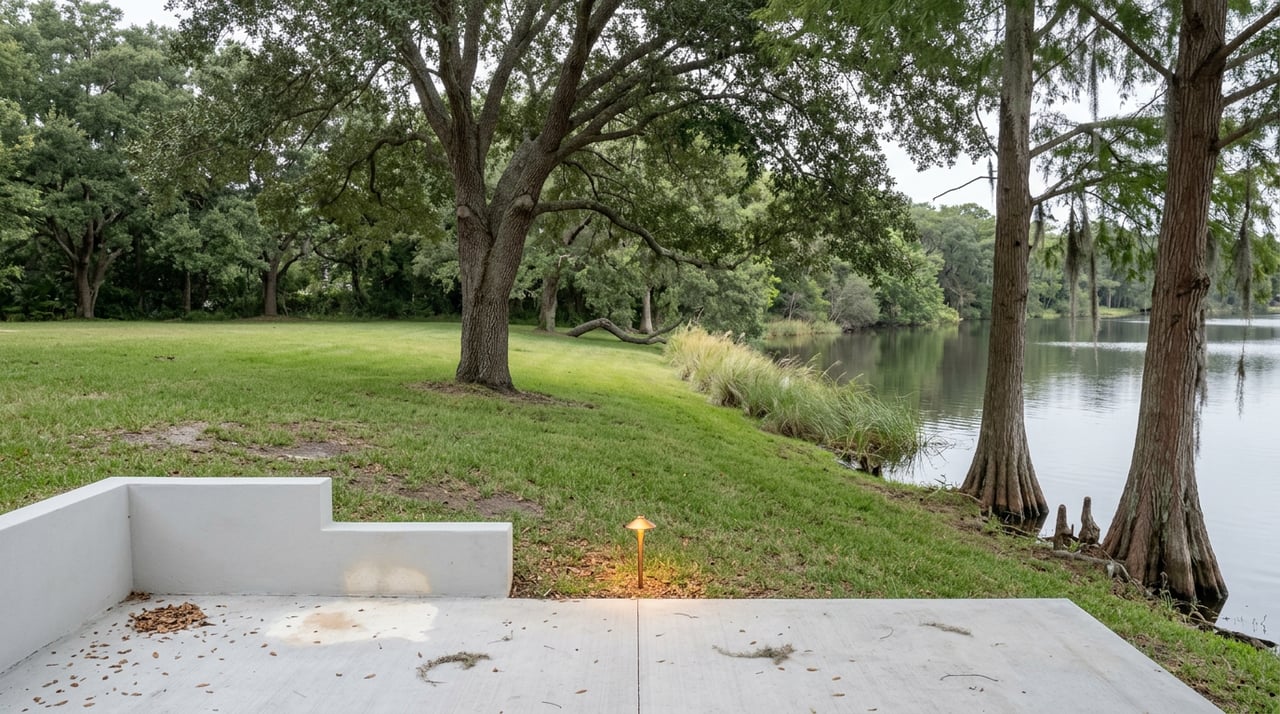
Drive the length of Lake Washington Road and you'll notice something that doesn't quite add up. The east side has a boat ramp, a park, houses on acreage, and a water treatment plant humming along behind a fence line. The west shore has none of that. No docks, no rooftops, no clearing in the tree line. Just water, marsh grass, and whatever's willing to live in it.
That's not an accident of zoning or a developer who never got around to it. It's downstream of what this lake actually is. Lake Washington isn't a lake in the way most people picture one. It's a wide, slow-moving stretch of the St. Johns River, held in place by a weir at its north end, and it happens to be one of only two surface water bodies in the entire St. Johns River Water Management District's 18-county territory that the region still relies on for drinking water. The other is Taylor Creek Reservoir, which supplies Cocoa. Lake Washington supplies you, along with a lot of your neighbors up and down the coast, according to an SJRWMD account of the river's upper basin.
Once you know that, the two shores stop looking like a coincidence and start looking like a plan.
The Working Side and the Wild Side
The east shore is where the infrastructure lives. That's where you'll find Lake Washington Park, the city of Melbourne's drinking water production facility, and the only public access point for miles. The west shore, by contrast, stays wilderness because keeping it that way protects the water quality of a source the city actively depends on. The city blends up to 18 million gallons of lake water per day with well water, treats it to drinking standards, and distributes it to a service area of roughly 182,000 people across Melbourne, Melbourne Beach, Indialantic, Indian Harbour Beach, Satellite Beach, Palm Shores, Melbourne Village, and parts of unincorporated Brevard County, per the same SJRWMD report.
That's a wider circle than most people assume when they hear "Lake Washington." If you live in any of those coastal communities, water from this lake has probably come out of your tap.
Here's the contrast in plain terms:
| East Shore | West Shore | |
|---|---|---|
| Access | Boat ramp, pier, park facilities | None, undeveloped shoreline |
| Development | Lake Washington Park, water treatment plant | Wilderness and floodplain |
| Public use | Fishing, boating, birding, picnics | Viewed from the water only |
The park itself sits on 25.96 acres along the developed shore, with a two-lane boat ramp for power boats, a separate airboat launch, a 120-foot fishing pier, a floating dock, and three small pavilions plus one large one that seats over a hundred people, according to Fun 4 Space Coast Kids' facility listing. It's a genuinely well-built piece of county infrastructure. It just happens to sit on the half of the lake that was always going to get built up, because the other half was never meant to be.
Fishing It Like You Already Know the Water
The Florida Fish and Wildlife Conservation Commission lists Lake Washington as a bream, crappie, largemouth bass, and catfish fishery, with shore anglers finding luck around the pads and bulrushes near the public fishing pier. That tracks with what a local kayak angler documented after a December outing on the lake. He launched from the park, worked the shoreline north for close to three hours without a bite, then turned around and headed south instead, targeting emergent grass and lily pads along the shore and the mouths of two canals where they meet the lake. That's where the pattern clicked. Once he found it, he landed between 20 and 25 bass over the next few hours, all on the same stretch, per his write-up on Spacefish.
The lesson isn't the fish count. It's the shift in approach. Open water and the main shoreline north of the ramp can go quiet for hours. The canal mouths and the grass lines to the south are where the lake actually produces. If you've fished here before and wondered why some mornings feel dead until almost lunch, that's consistent with what other anglers have reported too. Topwater lures, swim baits, and chatterbaits struck out entirely on that same December day before the pattern shifted to slower, grass-adjacent presentations.
What the Birders Already Know About Weekends
The east shore's popularity has a side effect that's useful if you'd rather watch wildlife than catch it. The boat ramp gets busy on weekends, and boat traffic pushes a lot of the more sensitive species toward the lake's quieter southern end. The Florida Birding Trail's official listing for the park recommends launching a kayak or canoe on a weekday specifically to improve your odds of spotting a Snail Kite, a species that's sensitive to disturbance and tends to work the calmer water away from the ramp.
The species list here is longer than a casual glance at the park would suggest:
- Wood Storks, Least Bitterns, Greater Yellowlegs, Purple Gallinules, and Limpkins along the waterfront
- Bald Eagles, Snail Kites, and Northern Harriers, all confirmed at the site
- Marsh and Sedge Wrens in winter, tucked into the weedy edges
- Red-eyed Vireos, Bobolinks, and Magnolia Warblers passing through during migration
- Painted Buntings, sometimes present in winter months
That's according to the Florida Birding Trail's site page for Lake Washington Park, which also notes the park sees heavy boat and airboat traffic on weekends. If you've ever wondered why your best sightings tend to happen on a random Tuesday morning rather than a Saturday, that's why.
Where the Afternoon Usually Ends
If your outing on the lake doesn't end at your own dock, there's a good chance it ends south on the St. Johns River at Camp Holly, on US-192 in West Melbourne, just off I-95 at Exit 180. Camp Holly has its own boat ramp, and reviewers describe airboats there running in and out toward Lake Washington itself. The property calls itself the first fish camp in Brevard County, and its own site traces its roots to the early 1920s, when it started as Bob Wall's Camp before being renamed in the 1960s, though other listings and reviews cite a founding date as early as 1901. Either way, it's grown into something with a lot more going on than a boat launch: a gift shop, a full tiki bar, a restaurant called Gators Grill, and live music most weekends on the back deck, according to Camp Holly's own site.
It's the kind of place where the outing itself becomes secondary. You go for the airboat ride or the fishing, and you stay because the patio is shaded, the barbecue sandwich is solid, and there's a guitarist playing from the far end of the property that's close enough to enjoy without drowning out conversation. That rhythm, morning on the water and afternoon on the deck, is close to the default Saturday for a lot of people who live near this stretch of river.
Two Jobs, One Lake
None of this is really about the fish or the birds or the tiki bar on their own. It's that all three only make sense once you understand the lake is doing two jobs at the same time. It's a working reservoir that keeps the tap running in six or seven coastal communities, and it's a recreational lake with a real fishery and a real birding reputation. Those two jobs don't compete. The reservoir function is exactly why the west shore stayed wild, and the wild west shore is a big part of why the fishing and birding on the east side stayed good enough to draw people out here in the first place.
If you've lived near this lake for years and never quite put those pieces together, you're not alone. Most people treat the name at face value and never ask why the far shore looks the way it does.
If you're weighing what a home near this stretch of the St. Johns River is actually worth, given how much of its value depends on things a standard listing photo can't show, that's a conversation worth having with someone who already knows this water. Jeremy Stewart has spent years working this exact stretch of Brevard County and can walk you through a free, no-obligation home valuation whenever you're ready to see where your property stands.